
Pallankuzhi
Count shells and plan ahead.
- Players
- 2
- Ages
- 5 and up
- What you need
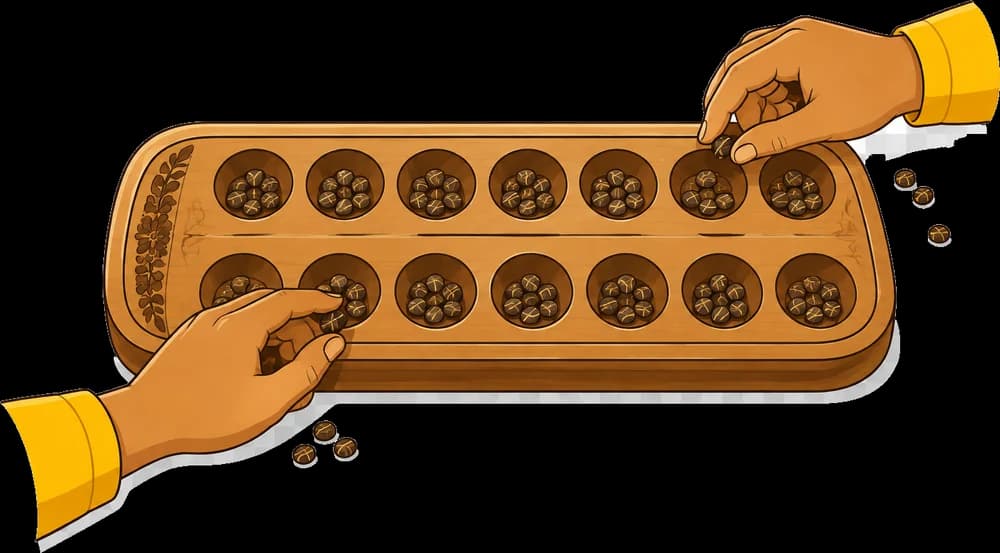
- A pallankuzhi board (or fourteen small pits scooped in sand) and about 70 shells, seeds or tamarind stones
Pallankuzhi has been played in Tamil homes for centuries, often on a carved wooden board passed down through a family. Grandmothers taught it to grandchildren on hot afternoons, and nobody ever called it a maths lesson. But a child who has played a hundred games has counted to seven tens of thousands of times — and that is why they never need to think twice about it later.
How to play
- 1The board has two rows of seven pits. Each player owns one row.
- 2Place five counters in every pit to start.
- 3On your turn, lift all the counters from one of your pits and drop one into each following pit, moving anti-clockwise.
- 4When your last counter drops into a pit, pick up everything in the next pit and keep going.
- 5If the next pit is empty, your turn ends — but you collect the counters from the pit after it.
- 6Play until the counters run out. Whoever has collected more wins.
Good for the body
Gentle on the body but excellent for the hands — picking up and placing small counters one at a time builds the fine finger control that neat handwriting depends on.
Good for the brain
You are counting, adding and predicting several moves ahead, all at once. Children who play regularly get noticeably faster at mental arithmetic, because the game rewards it every single turn.
A note for parents
This is counting practice disguised as a game. Children work out sums several moves ahead without ever feeling like they are doing maths, and it is quiet enough for a hot afternoon indoors.
Played today?
Ask a parent before going outdoors.